

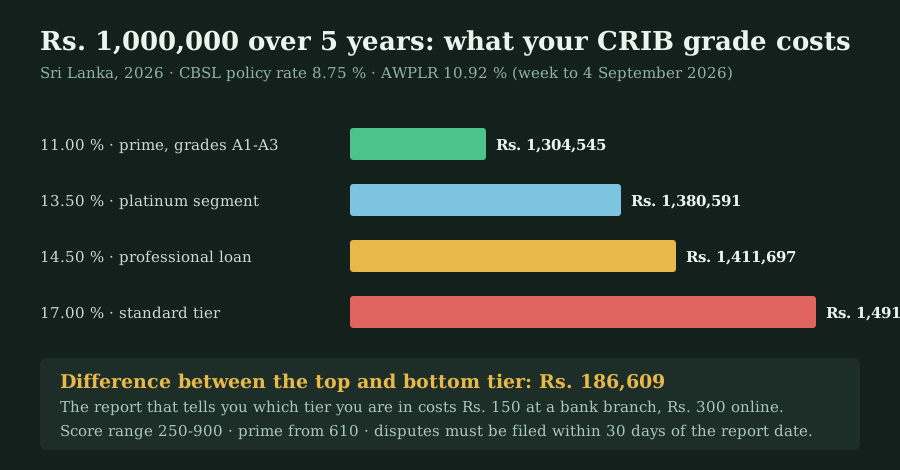

A CRIB self-inquiry report costs Rs. 300 online at crib.lk or through the MyCRIB app, and Rs. 150 if you apply at a licensed commercial bank branch. It is arguably the cheapest financial document in Sri Lanka relative to what it decides: your CRIB grade is what separates a personal loan at 11.00% from the same loan at 17.00%. On Rs. 1,000,000 over five years that gap is Rs. 186,609 — about Rs. 3,110 every month.
The score runs from 250 to 900. Banks treat 610 and above — risk grades A1 to A3 — as prime, which is where the concessionary pricing lives. Below that you are not blocked, but you are quoted differently, and nothing on the application form will tell you which side of the line you are on.
How to get the report in 2026
| Channel | Fee | Delivery |
|---|---|---|
| Online at crib.lk (MyReport, formerly iReport) or the MyCRIB app | Rs. 300, card payment | emailed within 24 working hours |
| Any licensed commercial bank branch | Rs. 150 | registered post to your address |
| CRIB office, No. 201, Sir James Peiris Mawatha, Colombo | counter fee | over the counter |
Note the pricing: the convenient channel costs twice the branch channel. You need a valid NIC, passport or driving licence showing the NIC number; online applications require a clear colour photograph of both sides of the original document. NDB customers can also request the report digitally through NDB NEOS.
What the grade is worth in rupees
Sri Lankan banks price personal loans in tiers, and the tier is set by your CRIB grade. Rates published between July and August 2026:
| Bank and segment | Rate | Rs. 1,000,000 over 5 years, monthly | Total repaid |
|---|---|---|---|
| People’s Bank, PrimeScore Privilege (grades A1-A3) | 11.00%-11.50% | Rs. 21,742 | Rs. 1,304,545 |
| Cargills Bank, professionals | 12.00% | — | — |
| Commercial Bank, Platinum segment | 13.50% | Rs. 23,010 | Rs. 1,380,591 |
| Sampath Bank, professional loan | 14.50% | Rs. 23,528 | Rs. 1,411,697 |
| Commercial Bank, standard 7-year | 17.00% | Rs. 24,853 | Rs. 1,491,155 |
For context, the Central Bank held its Overnight Policy Rate at 8.75% on 22 July 2026, and the Average Weighted Prime Lending Rate stood at 10.92% for the week ending 4 September 2026. A prime borrower at 11.00% is therefore being lent to at roughly the rate banks charge their best corporate customers; a standard-tier borrower pays six points above it. That spread is the price of the grade, not of the money.
September 2026 update: the rate environment behind the grade
Two numbers explain why the CRIB grade matters more this year than in the recent past. The Central Bank held its Overnight Policy Rate at 8.75% on 22 July 2026, and the Average Weighted Prime Lending Rate was 10.92% for the week ending 4 September 2026. Personal loan pricing sits between 11.00% and 17.00% depending on tier.
| Benchmark | Level | Date |
|---|---|---|
| CBSL Overnight Policy Rate | 8.75% | held on 22 July 2026 |
| Average Weighted Prime Lending Rate | 10.92% | week to 4 September 2026 |
| Personal loans, prime tier | 11.00%-11.50% | July 2026 |
| Personal loans, standard tier | up to 17.00% | 18 August 2026 |
A prime borrower is being offered money at roughly the prime lending rate itself, which is as close to the floor as retail credit gets in Sri Lanka. Everything above that line is priced risk, and the grade is the only variable in the formula you can influence before you apply.
There is no CRIB blacklist
The most persistent myth in Sri Lankan borrowing is that CRIB maintains a blacklist and that being on it bars you from credit. It does not. CRIB is a statutory repository created by the Credit Information Bureau of Sri Lanka Act, No. 18 of 1990; member institutions upload their repayment data monthly and CRIB compiles it. It issues no opinion, approves nothing and blocks nothing — every lending decision belongs to the individual bank and its own policy.
What that changes in practice: a rejection is a decision by that specific bank against its own thresholds, not a verdict on you. Another lender with different appetite may price the same file differently, which is why reading the report yourself before applying matters more than guessing at the outcome. Rates and conditions across lenders are collected on our page comparing personal loan interest rates.
How long a bad entry stays, and what settling actually does
Negative repayment information remains visible for five years after full settlement; minor late payments generally persist for about three years. Settling a defaulted facility does not delete the record — the reporting institution transmits a monthly update and the status changes to show the facility as cleared. A future lender sees both the default and the resolution.
That has a practical consequence people usually learn too late: paying off an old default improves your file but does not reset it, so the sooner a dispute or a settlement is registered, the sooner the five-year clock starts. Waiting to "clear it later" simply moves the whole window later.
Disputing an error: 30 days, and the clock is strict
If the report shows a facility you never took, an amount you already paid, or a default that belongs to someone else, the correction procedure is defined and time-boxed:
- Get the report first. The dispute is filed against a specific issued report.
- Submit a Dispute Registration Form with evidence — payment receipts, settlement letters — either on paper or online through myreport.crib.lk.
- Deadline: 30 days from the report’s issue date. A form that reaches CRIB later is rejected, and you have to buy a fresh report to start again.
- Resolution: a minimum of 14 days for the reporting institution’s compliance officer to investigate.
- While it is open, the entry shows as an "Active Dispute" on later reports; if the claim is found incorrect it is flagged as a "False Dispute".
The 30-day rule is the reason to pull your report before you need the loan rather than during the application: a disputed entry discovered a week before a property deadline cannot be corrected in time, and the "Active Dispute" flag itself is visible to the lender you are applying to. If your file already carries arrears, our guide to borrowing with a damaged record covers the realistic options.
What to do, in order
- Buy the report at a bank branch for Rs. 150 unless you need it within a day.
- Check the score against 610. Above it you should be quoted prime tiers; if you are not, ask the bank which grade it used.
- Read every facility line, including closed ones. Guarantees you gave for someone else appear here too and count against you.
- File any dispute inside 30 days of the report date, with documents attached.
- Pull the report at least two months before a loan application, so a correction has time to complete.
- Do not pay anyone to "clear" your CRIB record. No such service exists: entries update only when the reporting institution transmits new data.
Fees and rates on this page are those published between July and September 2026 and move with the market; the Act, the score range and the dispute deadlines are stable and are what actually govern the process.
One consequence worth planning around: because the spread between tiers is set by the bank rather than by the policy rate, a fall in the Central Bank rate does not automatically narrow it. Waiting for cheaper money will not move you from the standard tier to the prime tier — only the record does that, and the record updates monthly as institutions transmit their data.
So the sequence that saves money is fixed: pull the report, correct anything wrong within the 30-day window, let the corrections and any settlements register in the monthly cycle, and apply afterwards. Doing it in the other order means being priced on a file you have not read, and on this page the difference between the two approaches was measured at Rs. 186,609 over five years.